You Don't Know What You Want in Bed. Neither Does Your Partner. The Research Proves It.
Eastwick et al. (2024) studied 10,358 people across 43 countries. The finding: what people say they want in a partner barely predicts what actually drives their satisfaction. The corrected metric was β = .19 — barely above noise. Both men and women systematically misunderstood their own desires.
The trait people ranked only 12th on their stated list — "good lover" — turned out to be the #1 predictor of actual relationship satisfaction in revealed preferences.
Every piece of sex advice you've ever received is built on stated preferences. Magazine listicles, Reddit threads, well-meaning conversations with your partner — all of them rely on what people say they want. And the science says that's a weak predictor of what actually works.
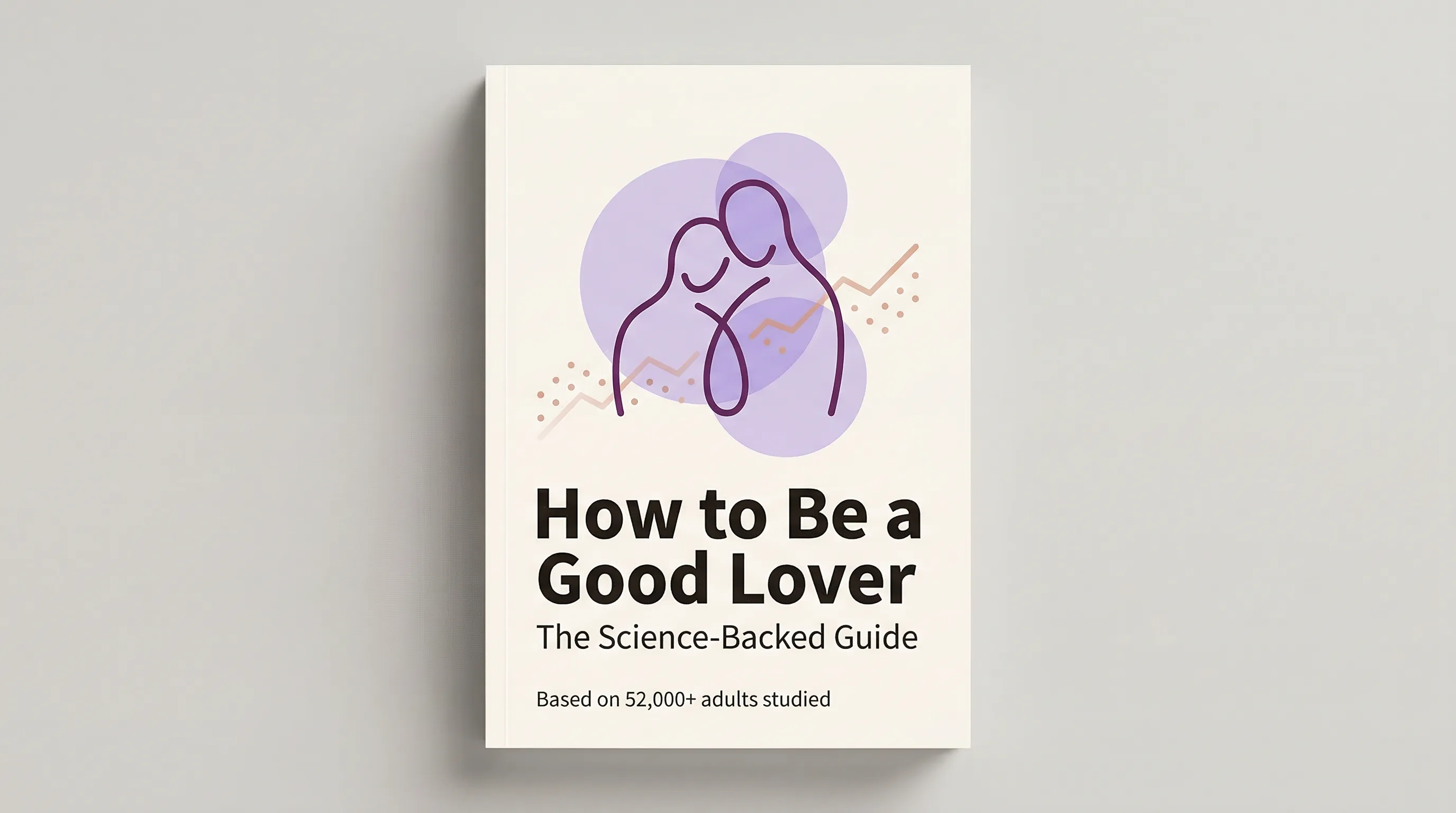
This is the Revealed Preferences Playbook. Not a tips-and-tricks article from Cosmopolitan. Not a 300-page book you'll never finish. A distilled, research-backed guide that covers what actually predicts sexual satisfaction — based on studies of 52,000+ adults — with specific communication scripts, clinical exercises, and a 30-day action plan you can start tonight.
Why This Works Where Free Advice and Expensive Therapy Don't
Healthline tells you to "communicate more" and "try a new position." Reddit tells you to "just leave." Come As You Are is a brilliant 300-page book about female psychology that most couples never finish. She Comes First reduces intimacy to a single mechanical act. A sex therapist costs $150 to $300 per session — and the shame barrier stops most people from ever booking the first one.
This guide closes three gaps that every other resource ignores:
- The science translation gap — Decades of peer-reviewed research on sexual satisfaction exists in academic journals behind paywalls and jargon. This guide translates it into specific, actionable frameworks with every claim cited. Eastwick's preference-matching paradox. Frederick's orgasm gap data from 52,000 adults. Nagoski's dual control model. Gottman's research on 3,000+ couples. Masters & Johnson's sensate focus protocol. MacNeil & Byers' communication framework. All in one document. Zero fluff.
- The both-partners gap — Most intimacy resources target one gender. Books for men focus on technique and performance. Books for women focus on self-acceptance and mindfulness. Neither addresses what the research actually shows: that both partners' understanding is required for either partner's satisfaction. This guide is designed for couples to read together — or separately — with exercises for both.
- The theory-to-practice gap — You already know that "communication is key." What you don't have is the exact script for initiating a conversation about desire without triggering defensiveness. The exact sensate focus protocol that therapists use with couples. The exact sequence of exercises that moves you from "we never talk about this" to "we did it and it worked." This guide provides the scripts, the exercises, and the 30-day plan — not the platitudes.
What's Inside the Complete Guide
You get the full 10-chapter guide, three printable standalone tools, and a one-page cheat sheet — every chapter grounded in peer-reviewed research with specific exercises you can start tonight:
- The preference-matching paradox — Why what people say they want and what actually predicts their satisfaction are almost completely different things (Eastwick et al., 2024). The four myths that silently wreck most people's sex lives. Why your past "failures" weren't failures — they were based on bad data.
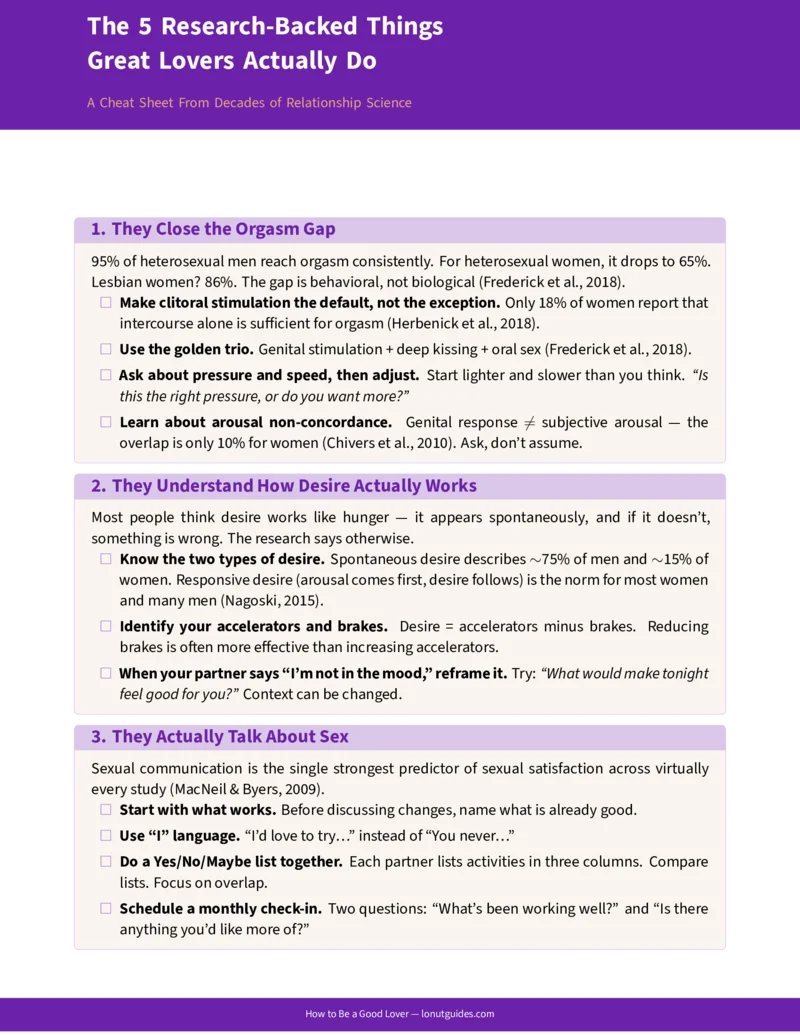
- The orgasm gap and how to close it — 95% of heterosexual men orgasm consistently. 65% of heterosexual women do. 86% of lesbian women do. Same anatomy, different outcome. The Frederick et al. (2018) study of 52,000 adults, the "golden trio" of behaviors that predict orgasm frequency, and arousal non-concordance — the concept most people have never heard of that changes everything.
- How desire actually works — Spontaneous desire describes ~75% of men and ~15% of women. Responsive desire — where arousal comes first, desire follows — is the norm for most women and many men. Neither is broken. They're different ignition sequences. The accelerators-and-brakes framework, a self-assessment for both partners, and what to do when "I'm not in the mood" means "the context isn't right."
- Sexual communication scripts — The MacNeil & Byers disclosure framework. Three specific conversations every couple should have: the desire conversation, the satisfaction conversation, the boundaries conversation. Word-for-word opening lines, follow-up questions, and in-the-moment scripts for during sex. Plus Yes/No/Maybe lists.
- The relationship foundation — Gottman's research shows sexual satisfaction is inseparable from relationship quality. Bids for connection (couples who stayed together responded to 86% of bids). The 5:1 positive-to-negative ratio. The 6:1 non-sexual-to-sexual touch ratio. The daily work that makes good sex possible.
- Attachment styles and sexual responsiveness — How secure, anxious, avoidant, and disorganized attachment patterns shape what you need in bed and how you respond to intimacy. Specific exercises for same-style and mixed-style pairings. The attachment quiz that therapists use.
- Sensate focus — the most validated technique in sex therapy — The structured touch protocol developed by Masters & Johnson, refined over 60 years of clinical use. Four progressive stages from non-genital touch to full intimacy. Specific instructions for each stage, what to do when it feels awkward, and how to debrief afterward.
- The science of foreplay and timing — The average heterosexual encounter is 5.4 minutes of penetration (Waldinger et al., 2005). Women need an average of 13.4 minutes of stimulation to orgasm (Kontula & Miettinen, 2016). The math is clear. Erogenous zone mapping, the arousal-timing mismatch, and practical techniques that don't feel performative.
- Maintaining desire over years — Why desire fades after 6 to 18 months (it's neurochemistry, not your fault). Self-expansion theory (Aron et al., 2000). How to create novelty within a long-term relationship. The 6:1 intimacy ratio. Strategies from longitudinal research on couples who sustain desire across decades.
- 30-day action plan — A structured week-by-week program. Week 1: self-assessment and communication. Week 2: sensate focus stages 1–2. Week 3: advanced techniques and experimentation. Week 4: integration and long-term habits. Each day is one specific exercise — nothing vague.
Plus 3 printable standalone tools — extracted from the guide so you can print them separately and keep them handy:
- 30-Day Action Plan — The week-by-week programme with checkboxes, self-assessment, and daily exercises on a printable 2-page sheet. Put it on your nightstand.
- Communication Scripts — Every word-for-word script from the guide: the disclosure framework, the three conversations, real-time verbal and non-verbal cues, and context reframes. Keep it handy for your next conversation.
- Sensate Focus Protocol — The 4-stage clinical protocol with specific instructions for each stage, timing, rules, common reactions, and debrief questions. Print it for your practice sessions.
Plus the 1-page cheat sheet: "The 5 Research-Backed Things Great Lovers Actually Do" — distills the entire guide into five actionable categories with checkboxes. Use it as a quick reference or a starting point.
Who This Is For
- You're in a long-term relationship where desire has faded. You love your partner, but the bedroom has gone quiet. You've tried "scheduling sex" and it felt mechanical. You've tried "communicating more" but didn't know what to actually say. The guide gives you the specific frameworks — responsive desire, accelerators and brakes, sensate focus — that explain why desire fades and the exact sequence for rebuilding it.
- You've read the books but couldn't apply them. Come As You Are was brilliant but 300 pages of theory. She Comes First focused on one act. Mating in Captivity was philosophically profound but didn't tell you what to do on Friday night. This guide distills the research from all of them into actionable frameworks with exercises you can start tonight.
- You want to close the orgasm gap. You've seen the statistic — 95% vs. 65% — and you want to understand why it exists and what to do about it. The guide covers the specific techniques, timing, and communication patterns that the research links to higher satisfaction for both partners.
- You're early in a relationship and want to build strong patterns. Most couples fall into habits during the first year that create problems a decade later. The guide shows you what the research says about desire cycles, communication norms, and physical intimacy patterns — so you build the right foundation instead of correcting course later.
- Your partner sent you this link. That takes courage on their part. It means they care about the relationship enough to raise a difficult topic. The guide doesn't lecture or blame. It presents the science, gives both partners exercises, and treats intimacy as a learnable skill — not a talent you either have or don't.
Why Not Just Use Free Resources?
Free resources describe the pain perfectly. They don't prescribe the cure.
Healthline and WebMD give you listicles written by content marketers, not researchers. "Try a new position." "Schedule date night." "Communicate more." These articles don't explore why desire fades, what arousal non-concordance means for your relationship, or how to actually talk about sex without triggering a defensive argument.
Reddit gives you emotional validation and anecdotal advice. The prevailing narratives in r/DeadBedrooms oscillate between "just leave" and "they'll never change." Neither is a clinical intervention.
YouTube and TikTok give you 60-second clips without sequential structure. You can't build a coherent intimacy framework from algorithmic fragments.
This guide synthesizes the actual peer-reviewed research — the same studies that sex therapists reference in session — into a structured, actionable plan with specific exercises. Every claim is cited. Every exercise has instructions. The 30-day plan gives you the exact sequence. If free advice worked, you wouldn't be reading this page.
— Less Than One Therapy Session
A single session with a sex therapist costs $150 to $300. OMGYes costs $49 to $99 per module. A Coral subscription is $60 a year. Those are good resources — but this guide covers territory none of them do: the intersection of the orgasm gap, desire science, communication frameworks, attachment theory, sensate focus, and long-term desire maintenance, all in one document with exercises and every claim cited to peer-reviewed research.
For less than the cost of two drinks at dinner, you get the foundational science that therapists spend the first five sessions teaching — plus a 30-day action plan to implement it.
If you learn just one thing from this guide that closes the orgasm gap, brings warmth back to the room, or stops the resentment from building — spending on peer-reviewed research was the smallest investment you'll make this year.
Satisfaction Guarantee
If this guide doesn't give you frameworks and exercises you can actually use in your relationship, email us and we'll refund you — no questions asked. The checkout is discreet. Your credit card statement shows a generic billing descriptor. Instant digital delivery — no physical package, no awkward email subject line.
Not ready to commit? Start with our free 5 Research-Backed Things Great Lovers Actually Do — a one-page cheat sheet distilling decades of relationship science into the five behaviours that predict sexual and relationship satisfaction.