You Taught Your Kids "Don't Talk to Strangers." Rescue Workers Wish You Hadn't.
Your child gets separated from you at a shopping centre. They're scared. They're surrounded by hundreds of people. And because you taught them that every stranger is dangerous, they do exactly what you trained them to do: they hide. They crouch behind a shelf. They stay silent. They refuse to approach the security guard standing ten metres away.
Meanwhile, the children who are found fastest — the ones in that reassuring 90%-within-30-minutes statistic — are the ones who were taught to walk up to a safe adult and say "I'm lost. My name is ___. Can you help me?"
The difference between those two outcomes is not luck. It is training. And most parents are training their children for the wrong outcome.
This is the Family Safety Operating System. Not a list of tips you'll read once and forget. Not a 300-page parenting philosophy book. A complete, practise-it-this-weekend toolkit built on the specific protocols that search-and-rescue volunteers, police detectives, and child protection professionals use to protect their own families — and designed for children aged 3 to 13.
Why Most Child Safety Advice Gets the Threat Model Wrong
The National Center for Missing & Exploited Children tracked 29,568 missing child reports in 2024. Stranger abduction accounted for 0.3% of them. Family abductions and endangered runaways accounted for over 96%.
Meanwhile, approximately 90% of child sexual abuse is perpetrated by someone the child already knows and trusts — a relative, a coach, a neighbour, a family friend.
Most safety advice focuses a child's entire defensive posture on the least likely threat. This guide rebuilds it around the actual risks: becoming separated and not knowing what to do, being manipulated by a trusted adult, and being groomed online by someone who will never set foot on their street.
What's Inside
- The Tricky People Framework — The behaviour-based approach rescue workers actually recommend. Safe adults don't ask children for help. Safe adults don't ask children to keep secrets. Your child learns to analyse what people do, not what they look like.
- Age-specific safety scripts (3–5, 6–9, 10–13) — A 4-year-old doesn't process risk the same way an 11-year-old does. Each age band gets word-for-word conversations calibrated to what children can actually understand and execute at that developmental stage.
- The Lost Child Protocol — What your child should do in the first 60 seconds at a mall, theme park, beach, or wilderness trail. What you should do in the first 5 minutes. Based on SAR operational procedures, not parenting blog advice.
- Tactical family drills you can practise this weekend — Because children revert to muscle memory under panic, not to lectures they half-remember. Role-play games, "what if" dinner table scenarios, and the weekend rehearsal plan that makes these protocols automatic.
- Body safety and abuse prevention — The bathing-suit rule, the "no forced secrets" policy, and the trusted adults contract. Covers the 90% of abuse that comes from people children already know — without traumatising your child or making them afraid of every adult.
- Digital safety foundations — Device-by-device settings for iOS and Android, age-appropriate online rules, and the grooming red flags every parent needs to recognise before handing over a screen. Covers the 1,325% increase in AI-generated exploitation material that NCMEC reported in 2024.
- The buddy system that actually works — Not just "stay with your friend." The specific rules, check-in signals, and age-appropriate modifications that make buddy systems functional instead of aspirational.
- Printable emergency cards and code words — Standalone wallet cards (emergency-card.pdf) with spaces for contacts, medical alerts, and your family code word. Print, laminate, and place in backpacks — plus the "I need help" script your child practises until it's automatic.
- Country-specific reporting contacts — A standalone quick reference (reporting-contacts.pdf) with emergency numbers and reporting agencies for the US (911/NCMEC), UK (999/NSPCC), Canada, Australia (000/Daniel Morcombe Foundation), New Zealand, and Singapore.
- Weekend implementation plan — A standalone checkbox schedule (weekend-plan.pdf) that turns the entire guide into practised family protocols over one Saturday-Sunday. Print it and check off each step.
Who This Is For
- You lost sight of your kid at the shops for 90 seconds and your heart still hasn't recovered. The Lost Child Protocol gives both you and your child a rehearsed action plan for the first 5 minutes — so the next close call has a procedure, not just panic.
- Your child is starting school and you're realising you can't be there every second. The age-specific scripts teach your child how to identify safe adults, set body boundaries, and ask for help — all calibrated for what a 5-year-old can actually remember under pressure.
- You just read something about the "tricky people" concept and want the complete system. This guide doesn't just explain it — it gives you the word-for-word conversations, the role-play games, and the weekend implementation plan to make it stick.
- Your child is about to get their first phone and you have no idea where to start. The digital safety chapter covers device settings, age-appropriate rules, and grooming red flags — practical setup instructions, not a lecture about screen time.
- You were raised on "stranger danger" and you know it's wrong, but you don't know what to replace it with. Chapter 1 systematically dismantles the 5 most dangerous safety myths and replaces each one with the evidence-based alternative that professionals actually use.
Why Not Just Google It?
You can. You'll find NCMEC's KidSmartz programme — excellent content buried across dozens of sub-pages designed for educators and law enforcement, not parents looking for a weekend action plan. You'll find Reddit threads with 400 comments arguing about whether "find a mom with kids" is good advice (it is, for under-7s; the guide covers when it stops working). You'll find Etsy printables with spaces to write emergency phone numbers but zero guidance on what your child should actually say or do.
What you won't find for free:
- A single document that synthesises SAR protocols, child psychology, body safety frameworks, and digital safety into one coherent family playbook
- Age-segmented scripts that account for the difference between what a 4-year-old and an 11-year-old can process under stress
- Physical role-play drills that build muscle memory — the thing that actually determines what a child does in a crisis
- A weekend implementation plan that turns scattered tips into practised, automatic family protocols
Pattie Fitzgerald's Safely Ever After workshops teach this material to schools for $7,500+ per assembly. Gavin de Becker's Protecting the Gift covers the philosophy in 352 terrifying pages. GPS tracker subscriptions cost $15–$20/month and tell you where your child is — but don't teach your child what to do when the battery dies.
— Less Than a Month of GPS Tracking
A GPS tracker subscription runs $15–$20 per month and tells you where your child is. This guide costs less and teaches your child what to do when you're not there — which is the part that actually matters.
A single kids' self-defence class costs $50–$200 and covers physical response to physical threats. This guide covers the psychological grooming, digital exploitation, and trust manipulation that precedes 90% of actual abuse cases — the threats that no martial arts class addresses.
If you're reading this because a close call at a park, a viral post, or a news story just made you realise your family doesn't have a plan, spending on a complete safety system is the smallest, fastest thing you can do tonight.
Satisfaction Guarantee
If this guide doesn't give you a concrete, practise-it-this-weekend safety plan for your family, email us and we'll refund you — no questions asked.
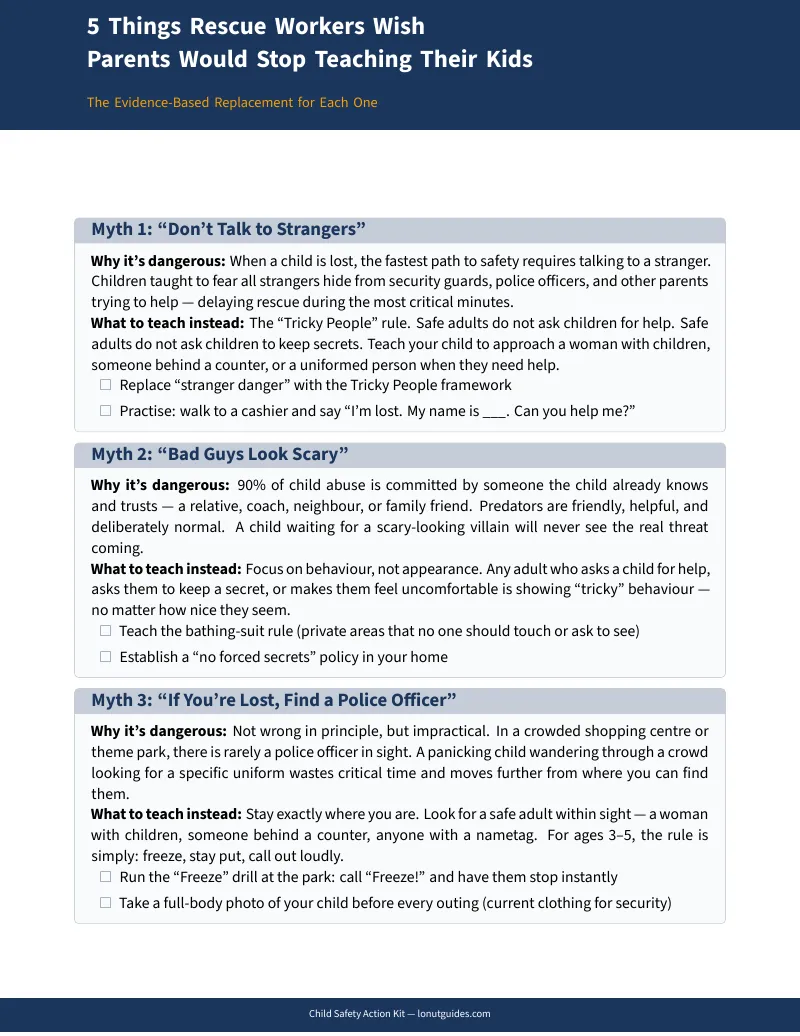
Not ready to commit? Start with our free 5 Things Rescue Workers Wish Parents Would Stop Teaching Their Kids — a 1-page PDF debunking the 5 most common safety myths, with the evidence-based replacement for each one.