You've Been Fighting Your Blushing for Years. That's Exactly Why It Keeps Winning.
You're in a meeting and someone asks for your opinion. Before a single word leaves your mouth, you feel the heat crawling up your neck. Your cheeks are on fire. Your brain splits into two tracks: one trying to form a coherent sentence, the other screaming "Everyone can see it. Everyone is staring."
You say something — probably fine, actually — but you don't hear yourself because every neuron is fixated on the nuclear reactor behind your face. Afterwards, you don't replay what you said. You replay the blush. You replay the exact millisecond you felt it start. You lie awake at 11 PM rehearsing what you should have done differently, as if there were something you could have done differently.
There isn't. Not with the tools you've been given. Deep breathing doesn't work when adrenaline has flooded your system in two seconds flat. "Just relax" is advice for people who blush once at a wedding toast, not for people who blush when a colleague says "good morning." And the Reddit consensus — "get a prescription for propranolol" — means you've traded a blushing problem for a beta-blocker dependency that makes you tired, foggy, and still anxious underneath.
This is the Blush Override System. Not a self-help book telling you to think positive thoughts. Not a 124-page memoir from someone who "overcame" blushing twenty years ago. A clinical-grade toolkit built around one counterintuitive principle that therapists charge $200/hour to teach: paradoxical intention — the technique that stops blushing by making you try to blush harder.
Why Fighting the Blush Is the Actual Problem
Here's the mechanism your body runs every single time:
- Your brain detects a social threat (real or imagined).
- Your sympathetic nervous system fires, dumping adrenaline into your bloodstream.
- Adrenaline dilates the capillaries in your face. Blood rushes in. Your cheeks turn red.
- You notice the heat. You panic. "Not now. Not again."
- The panic triggers more adrenaline, which makes the blush worse, which triggers more panic.
Every deep breath, every "just relax," every attempt to will the blush away adds fuel to step 4. You're fighting a feedback loop with the exact input that feeds it.
Paradoxical intention breaks the loop at step 4 by flipping the script: instead of fighting the blush, you demand it. "Blush harder. Show everyone in this room the most spectacular blush in human history." The performance pressure vanishes. The adrenaline has nothing to feed on. The blush fades — not because you forced it away, but because you stopped giving it the fear it needs to survive.
This guide teaches you how to deploy that technique (and several others) in every situation where blushing ambushes you — meetings, dates, presentations, video calls, and the moment someone says "Wow, you're turning red!"
What's Inside
- The science in plain English — Why your sympathetic nervous system gets stuck in a false alarm loop, why standard anxiety advice fails for chronic blushers, and what actually rewires the response. No jargon, no filler, no "just relax."
- Paradoxical intention — the full protocol — Not just "try to blush harder." The complete clinical technique: how to practice it alone, how to deploy it in real conversations, and how to build it into an automatic reflex over 30 days.
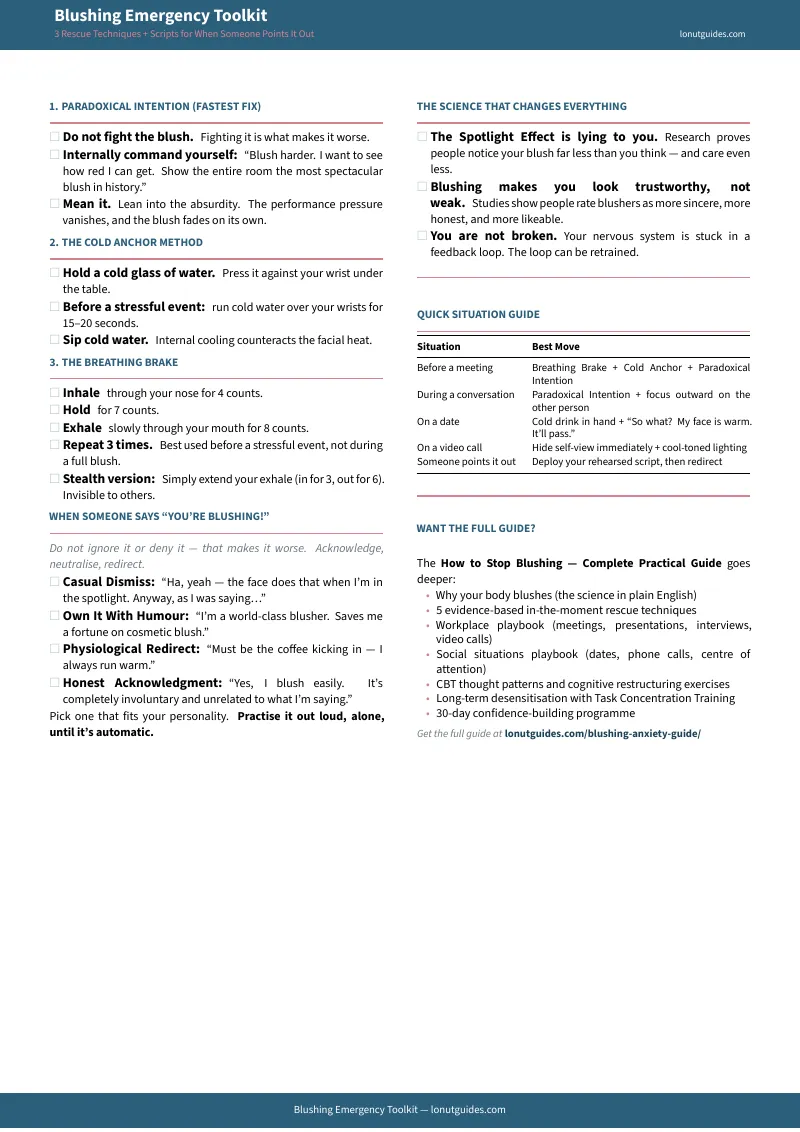
- 3 in-the-moment rescue techniques — The cold-anchor method, the breathing brake, and the paradoxical intention flash version. Each one works in under 10 seconds. Each one is invisible to everyone around you.
- Word-for-word scripts for "You're blushing!" — Four rehearsed responses for the single most terrifying moment a chronic blusher faces: someone pointing it out in front of everyone. Casual dismiss, own-it-with-humour, physiological redirect, honest acknowledgment. Pick one that fits your personality. Practise it until it's automatic.
- Situation playbooks — Step-by-step protocols for workplace meetings, job interviews, presentations, first dates, video calls, group dinners, and one-on-one conversations with authority figures. Each playbook covers before (preparation), during (rescue), and after (recovery).
- The CBT thought patterns fuelling your blushing — The spotlight effect, the mind-reading trap, catastrophic forecasting — mapped out with specific thought-replacement exercises. Not abstract theory. Concrete: "When you think X, replace it with Y."
- 30-day desensitisation programme — A structured exposure ladder that starts with low-stakes situations (ordering coffee, asking a stranger for directions) and builds to the hard stuff (speaking up in meetings, holding eye contact during a difficult conversation) by week four.
- The long game — Vagal tone exercises, cold-exposure protocols, and lifestyle factors (sleep, caffeine, alcohol) that lower your baseline sympathetic arousal over weeks, so the alarm fires less often in the first place.
Plus 4 standalone printables you can carry separately: a quick-reference card with all techniques and scripts, a workplace playbook with before/during/after protocols for 5 work scenarios, a CBT thought record worksheet, and a 30-day programme tracker with daily checkboxes.
Who This Is For
- You've blushed in meetings so many times you've stopped volunteering to speak. The situation playbooks give you a pre-meeting protocol and an in-the-moment rescue plan so you can participate without your face hijacking your credibility.
- Someone once said "You're going red!" and the memory still makes you flinch. The scripts section gives you four rehearsed comebacks that neutralise the comment in under three seconds — so you never freeze in that moment again.
- You've been told to "just relax" by people who've never felt their face burn for no reason. This guide was written for people with chronic, involuntary blushing — not occasional embarrassment. Every technique addresses the specific biology of erythrophobia.
- You've considered medication or surgery and you're not sure. The guide covers how propranolol, clonidine, and ETS surgery actually work (and their real side effects) so you can make an informed decision — but it gives you the non-pharmaceutical toolkit first.
- You lie awake replaying the blush, not the conversation. The post-event processing chapter teaches you how to shut down the midnight replay loop with a specific cognitive defusion exercise that takes three minutes.
Why Not Just Google It?
You can. You'll find Healthline telling you to "take deep breaths and drink cool water" — advice that works for normal embarrassment but is useless against a two-second adrenaline surge. You'll find Reddit threads where everyone recommends propranolol and someone eventually mentions nerve surgery. You'll find a 15-minute YouTube video you can't exactly pull up in a bathroom stall before walking back into a board meeting.
What you won't find for free:
- A step-by-step paradoxical intention protocol translated from clinical literature into language you can actually use
- Situation-specific playbooks for the exact environments where chronic blushers struggle most
- Rehearsable scripts for the moment someone publicly says "You're blushing!"
- A 30-day programme that systematically retrains your nervous system instead of just managing symptoms
Therapists teach this material at $150–$300/hour over 10+ sessions. This guide isolates the specific techniques that work for erythrophobia and delivers them in a format you can open on your phone five minutes before a stressful meeting.
— Less Than One Therapy Copay
A single therapy session costs $150–$300. ETS nerve surgery runs $5,000–$20,000 — with a 98% chance of trading blushing for compensatory sweating that soaks through your shirts. Beta-blockers require a prescription, a sympathetic doctor, and the willingness to feel permanently foggy.
This guide costs less than a single therapy copay. It exists because the most effective technique for chronic blushing — paradoxical intention — shouldn't be locked behind a $200/hour paywall.
If you're reading this at 11 PM after another day of replaying the blush, spending on a clinical-grade toolkit is the smallest, lowest-risk step you can take tonight.
Satisfaction Guarantee
If the techniques in this guide don't give you a concrete plan for your next blushing-trigger situation, email us and we'll refund you — no questions asked. We'd rather you get your money back than spend another day thinking nothing works.
Not ready to commit? Start with our free Blushing Emergency Toolkit — a 1-page cheat sheet with the 3 fastest in-the-moment techniques and scripts for when someone points out your blushing.